

S3 SEMINAR JMA-BE
The Cultural Value of the Public Space
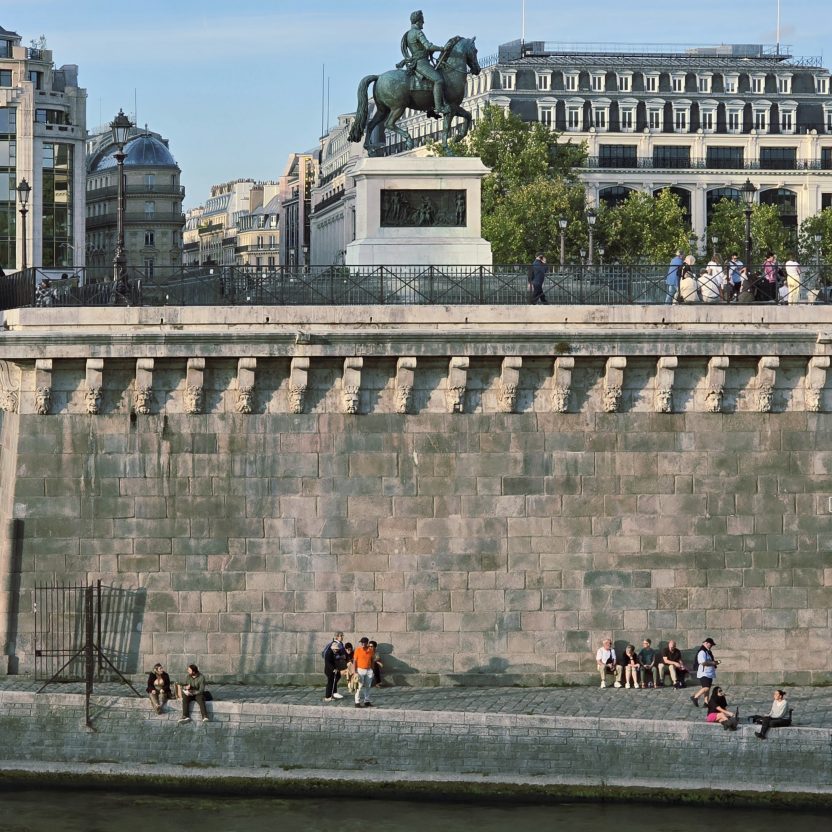 Espace public, Paris 2026, © Varian Ventil
Conent
In der Stadtsoziologie geht die Rede von der «Eigenlogik» der Städt. Wir senken die Flughöhe der Betrachtung. Wir gehen medias in res und fragen nach dem Eigensinn von Quartieren und insbesondere, welchen Bedeutung öffentliche Plätze für die Qualität des Zusammenlebens in den Quartieren haben. In Lektüren einschlägiger Klassiker der Soziologie und kleinen Feldforschungen unter Anwendung verschiedener Analyse-Methoden sind wir dem Quartiersgeist auf der Spur und suchen zu erkunden, ob er sich an bestimmten Orten manifestiert. Wie lebt es sich in den verschiedenen Quartieren? Gibt es da lokale Zentren, was spielt sich da im Alltag ab? Wo treffen sich die Menschen? Zu was für Interaktionen zwischen ihnen kommt es und wie hängt das zusammen mit dem gebauten Raum der Stadt? Wo wird die gebaute Infrastruktur zum Mitspieler, wo fördert, wo behindert sie Begegnung?
Wir erkunden Quartierszentren, wir analysieren und dokumentieren ihre Gestalt und Funktionen in Wort, Zeichnungen, Photographen und Film und beschreiben ihre lebensweltliche Bewandtnis. Durch vergleichende Betrachtung verschiedener Plätze versuchen wir genauer zu erfassen, wie an Beispielen von Quartiersplätzen soziale Praxis und räumliche-atmosphärische Qualitäten der gebauten Lebenswelt zusammenspielen.
En sociologie urbaine, on parle de la « logique propre » des villes. Nous abordons le sujet à un niveau plus concret. Nous allons au cœur des choses et nous nous interrogeons sur la spécificité des quartiers et, en particulier, sur l’importance des espaces publics pour la qualité de la vie en communauté au sein de ces quartiers. À travers la lecture d’ouvrages classiques de référence en sociologie et de petites recherches de terrain utilisant diverses méthodes d’analyse, nous partons à la découverte de l’esprit de quartier et cherchons à déterminer s’il se manifeste à certains endroits. Comment vit-on dans les différents quartiers ? Y a-t-il des centres locaux, que s’y passe-t-il au quotidien ? Où les gens se rencontrent-ils ? Quelles interactions s’établissent entre eux et quel est le lien avec l’espace urbain bâti ? Où l’infrastructure bâtie devient-elle un acteur à part entière, où favorise-t-elle les rencontres et où les entrave-t-elle ?
Nous explorons les centres de quartier, nous analysons et documentons leur forme et leurs fonctions à travers des textes, des dessins, des photographies et des films, et nous décrivons leur réalité quotidienne. En comparant différentes places, nous tentons de mieux cerner, à partir des exemples des places de quartier étudiées, comment les pratiques sociales et les qualités spatiales et atmosphériques de l’environnement bâti (« gebaute Lebenswelt ») interagissent.
In urban sociology, there is talk of the ‘inherent logic’ of cities. We are taking a closer, more grounded look. We go ‘medias in res’ and examine the distinct character of neighbourhoods and, in particular, the significance of public spaces for the quality of community life within them. Through readings of relevant classics in sociology and small-scale field research using various analytical methods, we are tracing the spirit of the neighbourhood and seeking to explore whether it manifests itself in specific locations. What is life like in the various neighbourhoods? Are there local centres there, and what goes on there in everyday life? Where do people meet? What sort of interactions take place between them, and how does this relate to the city’s built environment? Where does the built infrastructure become a contributing factor; where does it facilitate, and where does it hinder encounters?
We explore neighbourhood centres; we analyse and document their form and functions through text, drawings, photographs and film, and describe their role in everyday life. By comparing different squares, we aim to gain a more precise understanding of how, in the examples of the neighbourhood squares under investigation, social practices and the spatial and atmospheric qualities of the built environment (“gebaute Lebenswelt”) interact.
teaching aims
Verschiedene Methoden zur Beschreibung, Analyse und Dokumentation von räumlich-atmosphärischen und sozial-räumlichen Qualitäten.
Différentes méthodes de description, d’analyse et de documentation des qualités spatiales et atmosphériques ainsi que des qualités socio-spatiales.
Various methods for describing, analysing and documenting spatial-atmospheric and socio-spatial qualities.
teaching methods
Vorlesungen, Textdiskussionen, Feldforschung.
Cours magistraux, analyses de textes, travail de terrain.
Lectures, text discussions, fieldwork.