

OPTION JMA-BE
The Life of Materials (CH/IN)
Learning from Formal and Informal Circular Systems
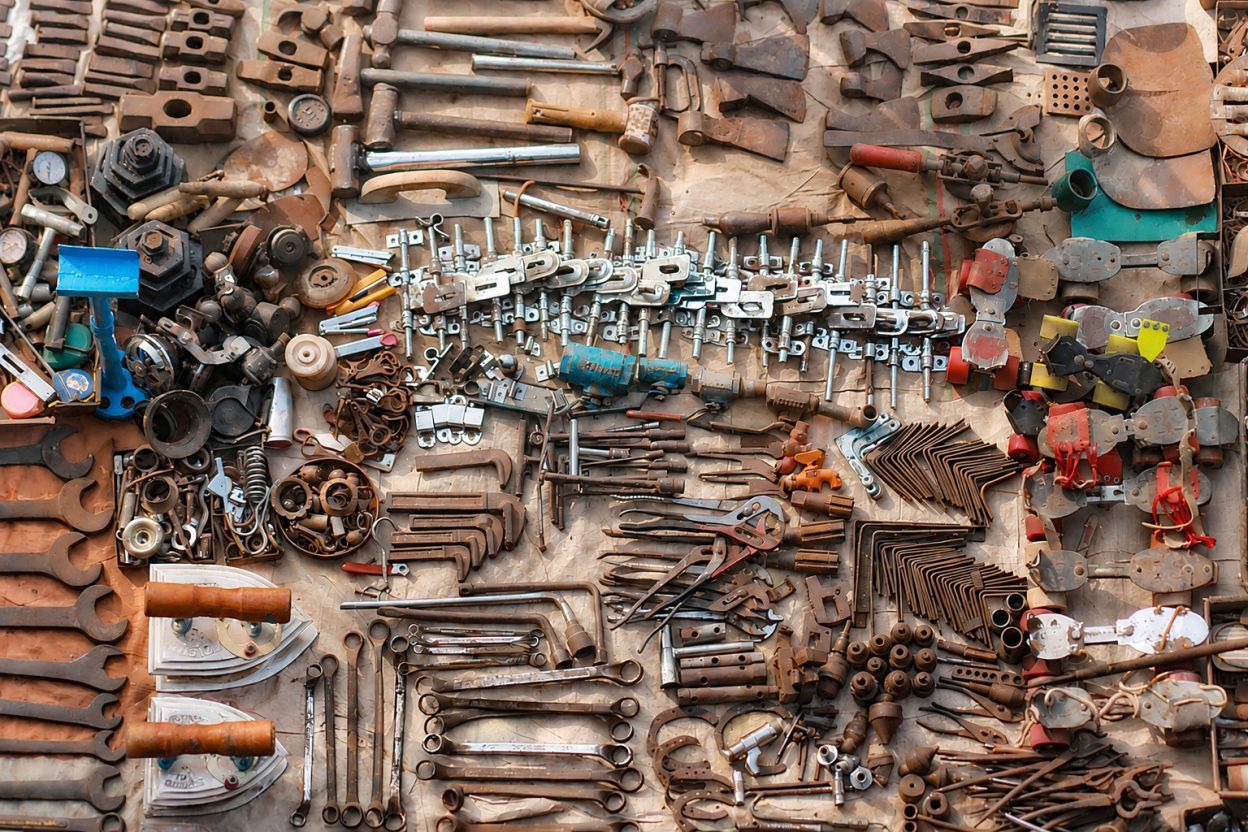 Tool Trader I”, Meanest Indian, CC BY-ND 2.0
Content
The module examines how material flows shape urban systems across different cultural contexts. Through collaborative learning, students compare formal and informal circular practices in Switzerland and India and explore their contribution to resilient urban development.
The Life of Materials explores circularity through the lens of material flows as part of the urban metabolism. The module investigates the spatial, social, logistical and ecological networks that enable materials to circulate, be repaired and reused. How can cities transition from linear systems of construction, demolition and waste towards circular and regenerative urban systems? Through a collaborative exchange between students in Switzerland and India, participants engage with both formal and informal circular practices and explore how different urban contexts respond to challenges such as resource scarcity, rapid urbanization and climate-related risks. The module opens a reciprocal dialogue between the two contexts, encouraging students to critically compare different approaches to adaptive reuse and urban resilience. Intercultural collaboration and mutual learning form the core of the module.
Teaching AIMS
Students develop systemic, analytical and intercultural competencies to understand and design for urban circularity across diverse cultural contexts.
Students develop a systemic understanding of urban circularity by investigating material flows, reuse practices and their spatial, social and ecological dimensions across different cultural contexts. Through field research, mapping and collaborative analysis, they learn to identify and critically interpret formal and informal circular systems and their contribution to urban resilience. Students investigate where, through which networks, and under which urban conditions reuse becomes possible at the urban scale. Working in intercultural teams, they strengthen their ability to engage with different knowledge systems, reflect on diverse planning cultures and develop context-sensitive design strategies and interventions. The module fosters analytical, methodological and collaborative skills while encouraging a shift in perspective from individual architectural objects towards urban systems and material ecologies.
TEACHING METHODS
The module combines collaborative online learning, immersive fieldwork and studio-based design in an intercultural learning environment.
The module combines online collaborative learning with immersive fieldwork in Mumbai and Switzerland. Students work in mixed intercultural teams through seminars, discussions, mapping exercises and collaborative research. The field phase includes site visits, stakeholder exchanges, on-site documentation and territorial analysis. The knowledge gained is translated into spatial strategies and design proposals, encouraging continuous exchange between students, teachers and local partners.
REQUIREMENTS
Required material:
Laptop, camera or smartphone for documentation, sketchbook/notebook, and standard architectural drawing materials.
Prerequisites:
None.
Estimated travel costs:
Estimated travel costs (including flights, accommodation and meals) are approximately CHF 1,500 per student. Project funding is expected to cover approximately CHF 500–600 per student. Additional financial support is currently being sought to further reduce the costs, particularly for students with financial need.